

Best AI agent reliability tools (2026): ship agents that don't fail in production
- Braintrust - Best overall. Pre-deploy evals, production observability, and regression debugging in one system, with the same scorer running before and after deploy. Includes a free tier.
- Galileo - Best for low-latency runtime guardrails that score production requests before responses reach users.
- Arize Phoenix - Best for open-source, self-hosted tracing built on OpenTelemetry.
- Promptfoo - Best for CLI-first teams that want open-source agent evals, regression tests, and red-team security checks in CI.
- AgentOps - Best for multi-framework and autonomous-research agents that need session replay and time-travel debugging.
What AI agent reliability means
A reliable AI agent must complete the full task correctly across every step in the sequence. A single step that succeeds 99% of the time can look stable in a short demo. Run that same step 100 times in sequence, and the probability that all 100 steps succeed drops to 0.99^100, or roughly 37%. The remaining 63% is attributed to task failure because small planning, retrieval, tool-call, or generation errors compound over a long workflow.
AI agent reliability is the measured rate at which an agent completes its task correctly across all workflow steps. That measurement depends on three connected stages. Pre-deploy evaluation scores the agent against golden datasets and custom scorers, and a CI gate blocks releases when quality drops. Production observability captures traces and live scores from real traffic, showing what the agent did and whether the output met the expected behavior. Regression debugging turns a failed production trace into a test case that the next eval run checks.
Two adjacent categories often get folded into reliability, but they cover narrower parts of the lifecycle. AI agent observability tools concentrate on production traces, logs, and metrics, while AI evaluation tools score outputs before deployment. AI agent reliability requires both stages to connect to regression debugging, so production failures become repeatable checks rather than isolated incidents.
How the AI agent reliability loop works
The AI agent reliability loop works when each stage feeds the next without manual rebuilding. An eval suite runs in CI and catches regressions before a pull request merges. After deployment, traces and live scorers capture failures not present in the eval set, because production traffic includes inputs that no test suite can fully anticipate. A failed production trace then becomes a regression case, and the next eval run checks it on every future change.
The loop is strongest when pre-deploy evals and production scoring use the same scorer. A quality score measured in development means the same thing in production, and a regression can be traced to a specific prompt, model, or tool change through side-by-side comparison. When CI and production scoring use different logic in separate tools, teams must translate results between systems before deciding whether a release is safe.
The connection between evaluation and production observability determines how quickly teams can fix agent failures. A tool in which LLM monitoring and pre-deploy evals share a single scorer can turn a production failure into a regression test with minimal handoff. A stack assembled from separate vendors may still work, but the same failure often requires a ticket, a manual dataset update, and a separate scoring job before the regression is covered.
What to look for in an AI agent reliability tool
A reliability tool should cover the full path from pre-deploy testing to production failure analysis. Use the criteria below to distinguish a reliability platform from a tool that covers only one stage.
- Pre-deploy eval coverage: Custom scorers, golden datasets, and CI gates that block low-quality releases before they merge.
- Production observability: Tracing for multi-agent systems, drift detection, and live scoring on real traffic.
- Regression-debugging UX: Side-by-side diffing and a direct path from a production trace to a regression test, which the AI agent debugging tools category treats as a first-class workflow.
- Custom-scorer flexibility: Agent-specific metrics like tool-call accuracy, task completion, and intent resolution, beyond generic correctness.
- Multi-framework support: Native instrumentation for LangGraph, CrewAI, the OpenAI Agents SDK, Mastra, and custom stacks.
- Open-source or self-host option: A path to run the tool inside your own infrastructure when data residency or licensing requires it.
A tool that covers a single criterion in depth can still be the right fit when the reliability requirement is narrow. For broader agent releases, the comparison table maps each tool to the stages it can support without manual work across separate systems.
5 best AI agent reliability tools in 2026
1. Braintrust
Best for: Teams that want pre-deploy evaluation, production observability, and regression debugging in one system, with the same scorer running before and after deploy.
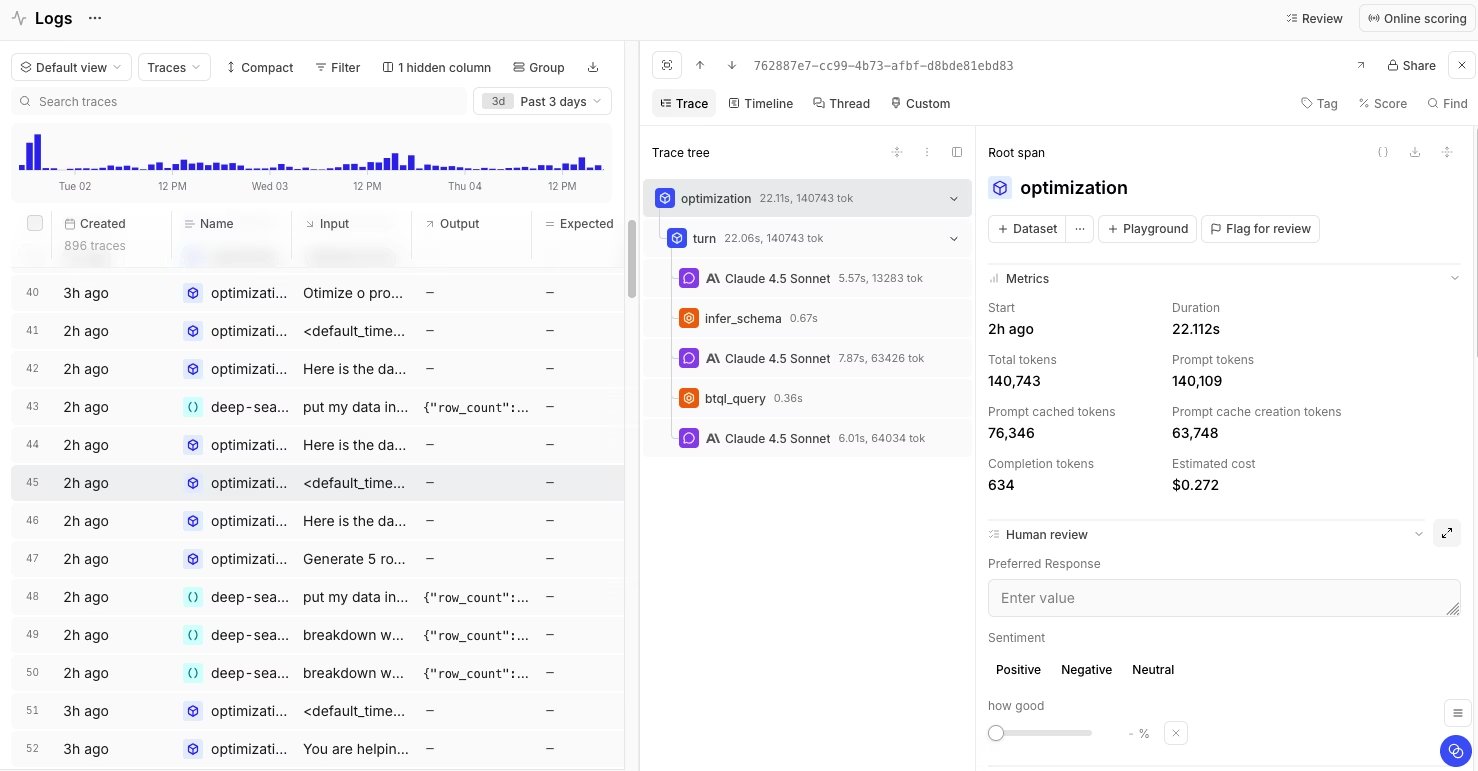
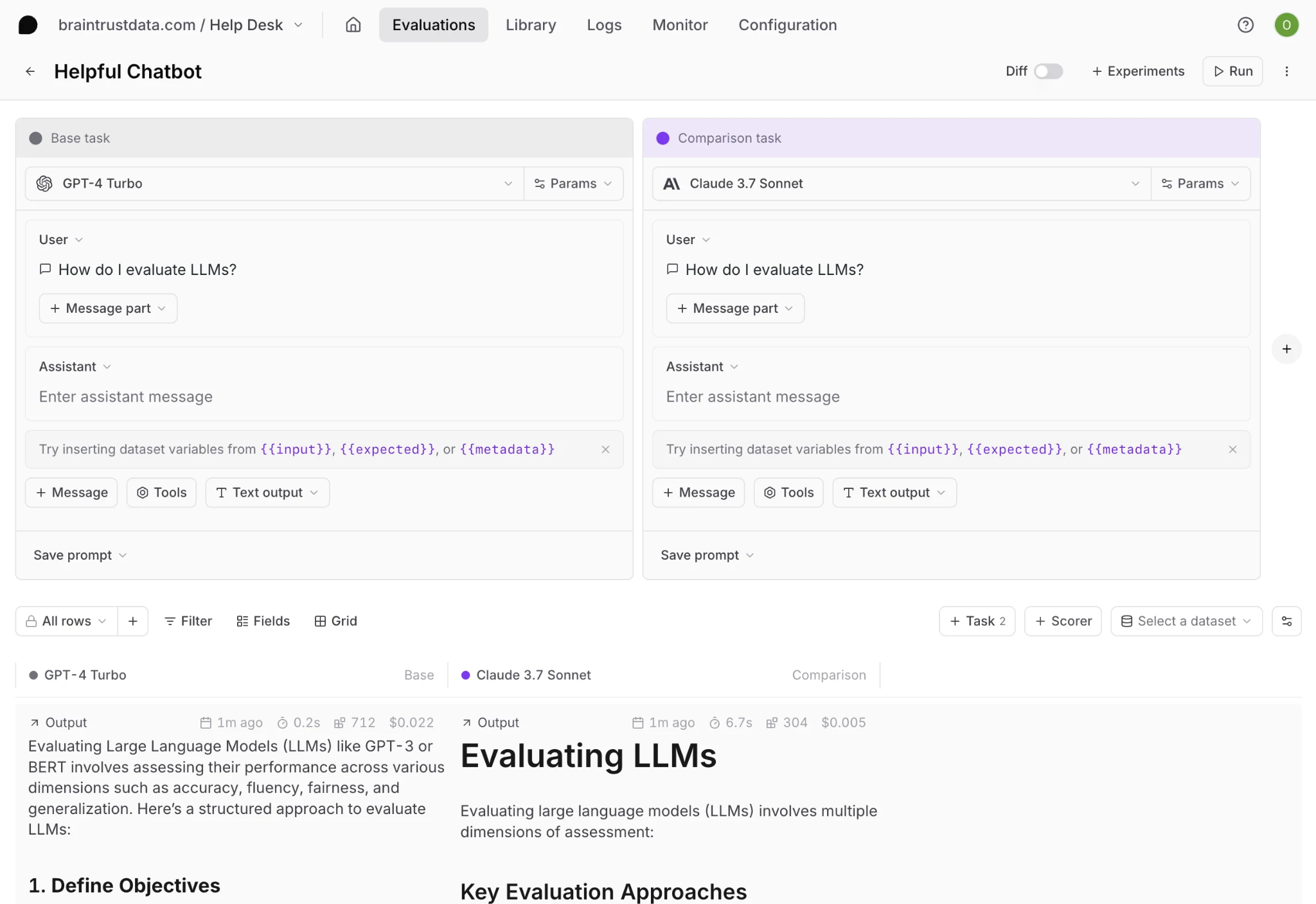
Braintrust is the best overall AI agent reliability tool for teams that want evaluation results to gate releases and convert production failures into future test cases, all without changing scoring logic between development and production. Teams can run pre-deploy evals on versioned datasets, compare prompt and model changes in experiments, inspect production traces, and add failed production cases to datasets for regression testing. The same custom scorer for tool-call accuracy, task completion, intent resolution, groundedness, or output quality can run in CI and on production traces through online scoring, so development quality and live quality use the same definition. CI checks can then block or flag changes before lower-quality agent behavior reaches production.
Braintrust also gives teams the trace detail needed to debug multi-step agent failures. Complete traces show spans, inputs, outputs, timing, metadata, tool calls, and model behavior across an agent run. When a production trace scores poorly, the team can inspect the exact step that failed, add the case to a dataset, and check the same failure in the next eval run. Side-by-side diffing helps compare prompt, model, or tool changes against the same dataset, so regressions can be tied to the change that caused them.
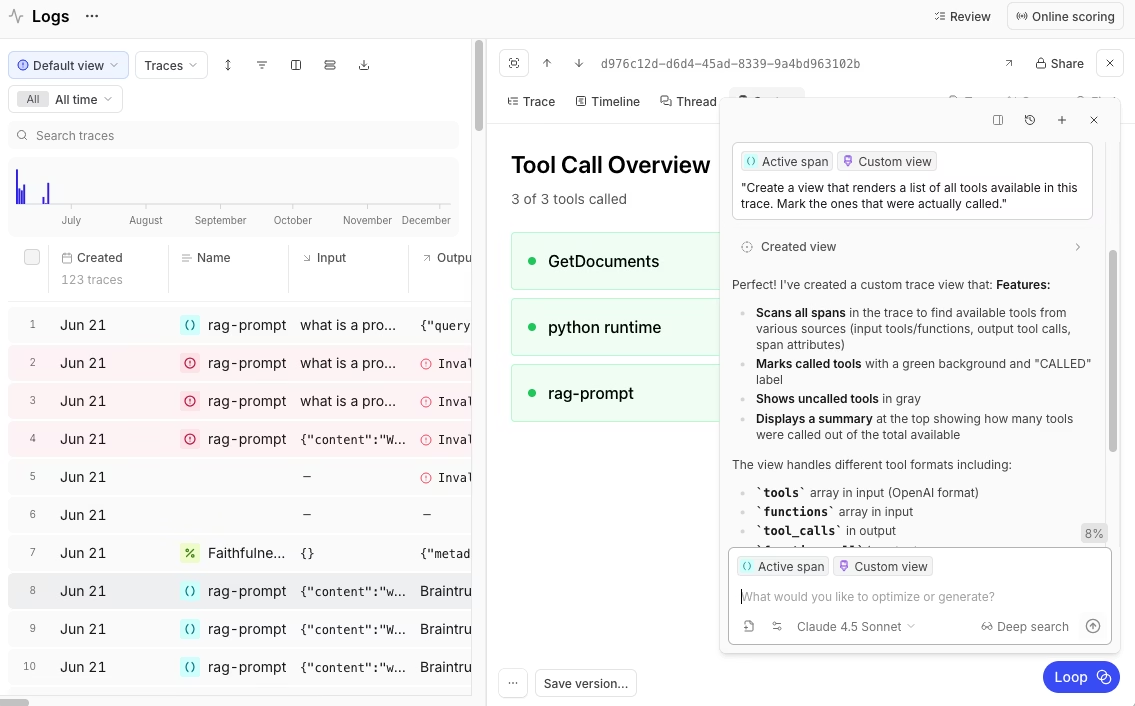
Loop allows product managers, domain experts, and support teams to participate in reliability work without writing code. They can analyze production logs and traces, generate filters, build datasets, create or improve scorers, and optimize natural-language prompts in playgrounds. Human review lets teams label traces, validate automated scores, and turn production examples into ground truth for future evaluations.
For instrumentation and deployment, Braintrust supports direct SDK integrations, OpenTelemetry ingestion, and the Braintrust gateway. The gateway routes requests across providers such as OpenAI, Anthropic, Google, AWS, and other supported providers while adding automatic observability and multi-provider support. Braintrust also supports agent framework integrations across LangChain, LangGraph, LlamaIndex, CrewAI, and the OpenAI Agents SDK, which keeps trace coverage close to how the agent is actually built. GitHub Actions can run evals on pull requests, giving teams a direct path from evaluation results to release checks.
Pros
- Full reliability workflow: Pre-deploy evals, production traces, online scoring, datasets, experiments, and regression debugging work in one system.
- Same scorer before and after deploy: Custom and built-in scorers can run in CI, experiments, playgrounds, and production logs.
- Regression coverage from production failures: Failed production traces can be added to datasets and checked in future eval runs.
- Side-by-side comparison: Teams can compare prompt, model, or tool changes against the same dataset to isolate regressions.
- Production observability: Traces capture spans, inputs, outputs, timing, metadata, and tool behavior across multi-step agent runs.
- Loop for team collaboration: Loop helps analyze logs, generate filters, build datasets, create scorers, and optimize prompts from natural language.
- Human review: Product teams and domain experts can label traces, validate automated scores, and create ground truth for reliability checks.
- Topics for production patterns: Topics can classify recurring patterns in logs, including task, sentiment, and issue patterns, helping teams identify repeated agent failures.
- Release control: GitHub Actions and CI/CD eval runs help teams block or investigate changes when quality drops.
- Framework and provider coverage: Braintrust supports OpenTelemetry, major agent frameworks, cloud and custom provider integrations, and Braintrust gateway routing.
- Free Starter plan: The Starter plan includes free usage and unlimited users, projects, datasets, playgrounds, and experiments.
Cons
- No inline blocking guardrails.
- Self-hosting is Enterprise-only.
Pricing
Free Starter plan with 1 GB processed data, 10K scores, and unlimited users. Pro at $249/month. Custom enterprise pricing. See pricing details here.
2. Galileo
Best for: Teams whose main requirement is runtime guardrails and live scoring for production AI systems.
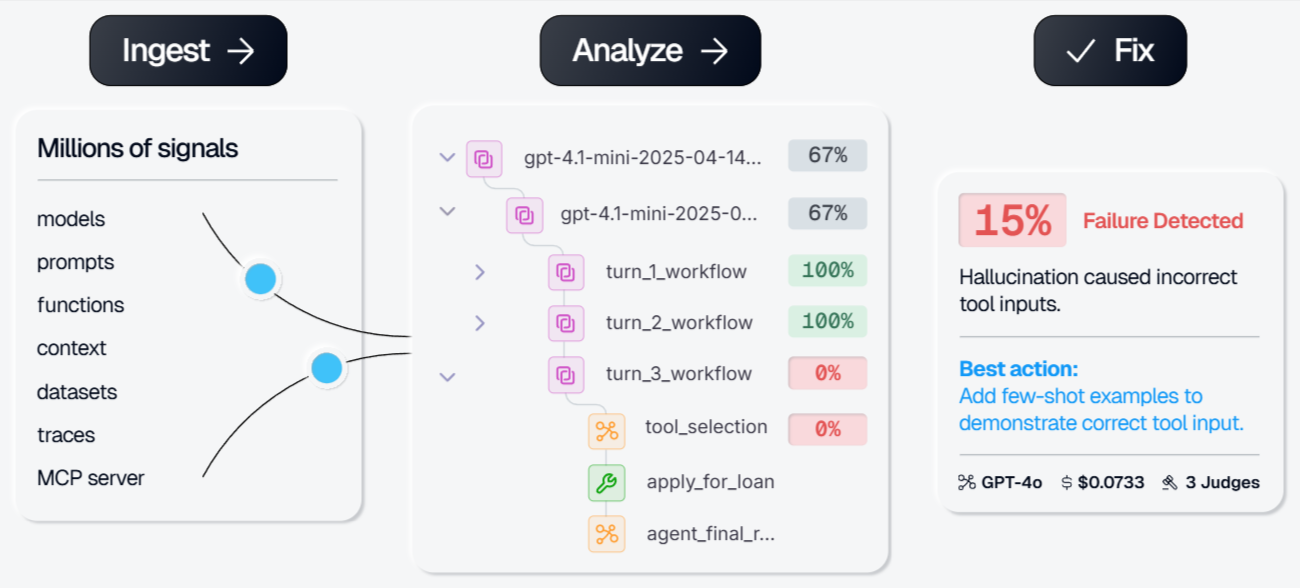
Galileo provides AI observability, evaluations, and guardrails for production GenAI applications and agents. The Enterprise plan supports offline evals, production monitoring, custom evaluators, failure analysis, and real-time guardrails. Galileo also released Agent Control as an Apache 2.0 open-source control plane for governing agent behavior across frameworks. It fits teams that prioritize runtime policy enforcement and production monitoring, while teams that need evaluation results to become CI release checks and regression datasets may need more manual workflow design.
Pros
- Runtime guardrails and live scoring for production AI systems.
- Custom evals and production monitoring in one platform.
- Agent Control provides an open-source control plane for agent behavior.
- Failure analysis workflows help teams group and inspect production issues.
Cons
- Real-time guardrails are Enterprise-only.
- Trace-to-regression workflows need more manual setup.
Pricing
Free tier with 5,000 traces/month. Paid plan starts at $100/month. Custom enterprise pricing.
3. Arize Phoenix
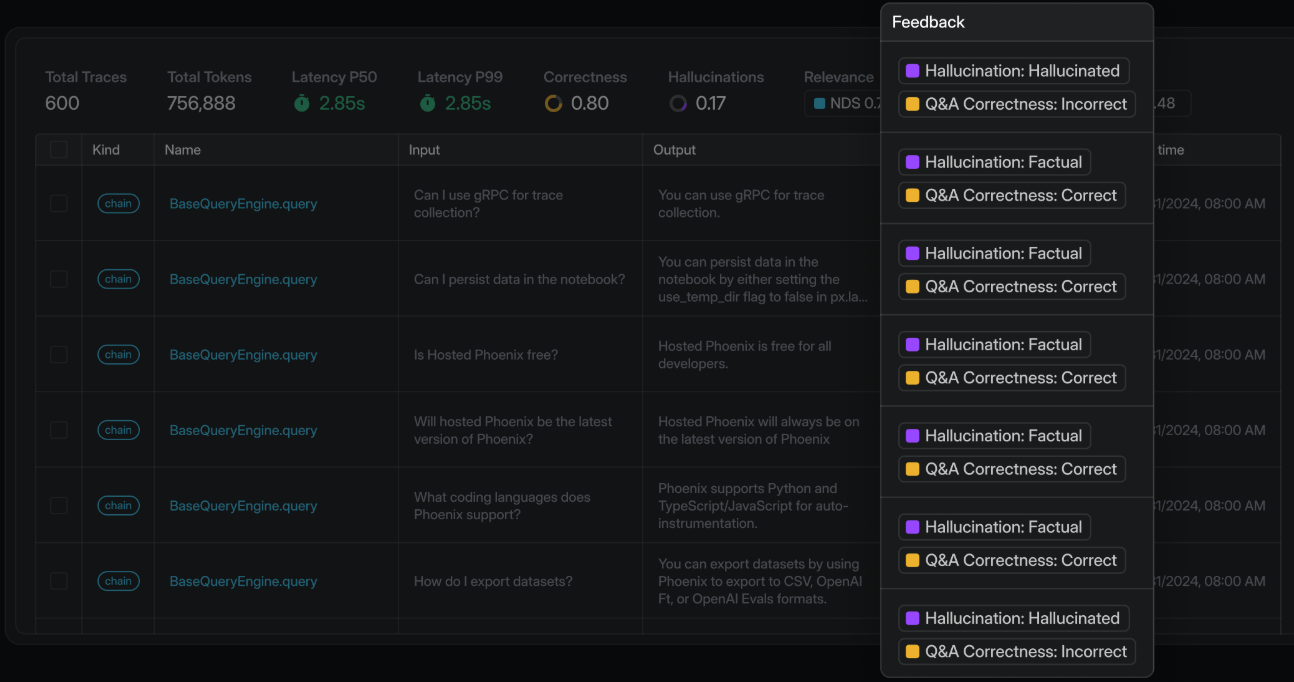
Best for: Teams that need open-source, self-hosted tracing and evaluation built around OpenTelemetry.
Arize Phoenix is an open-source AI observability and evaluation system for tracing, experiments, datasets, prompt iteration, and LLM-as-judge workflows. It uses OpenTelemetry-based instrumentation and OpenInference semantic conventions, which makes it a good fit for teams that want self-hosted trace capture and control over their observability data. Phoenix works well for teams that prefer open-source infrastructure, while managed production monitoring, longer retention, online evaluation, and enterprise support sit in Arize AX.
Pros
- Self-hosted tracing and evaluation.
- OpenTelemetry-based tracing through OpenInference.
- Supports tracing, datasets, experiments, prompt management, and LLM-as-judge evaluation.
- Works across common frameworks and providers.
Cons
- Managed production workflows usually move into Arize AX.
- Regression testing and CI gating require additional setup.
Pricing
Free for open-source self-hosting. Managed cloud at $50/month. Custom enterprise pricing.
4. Promptfoo
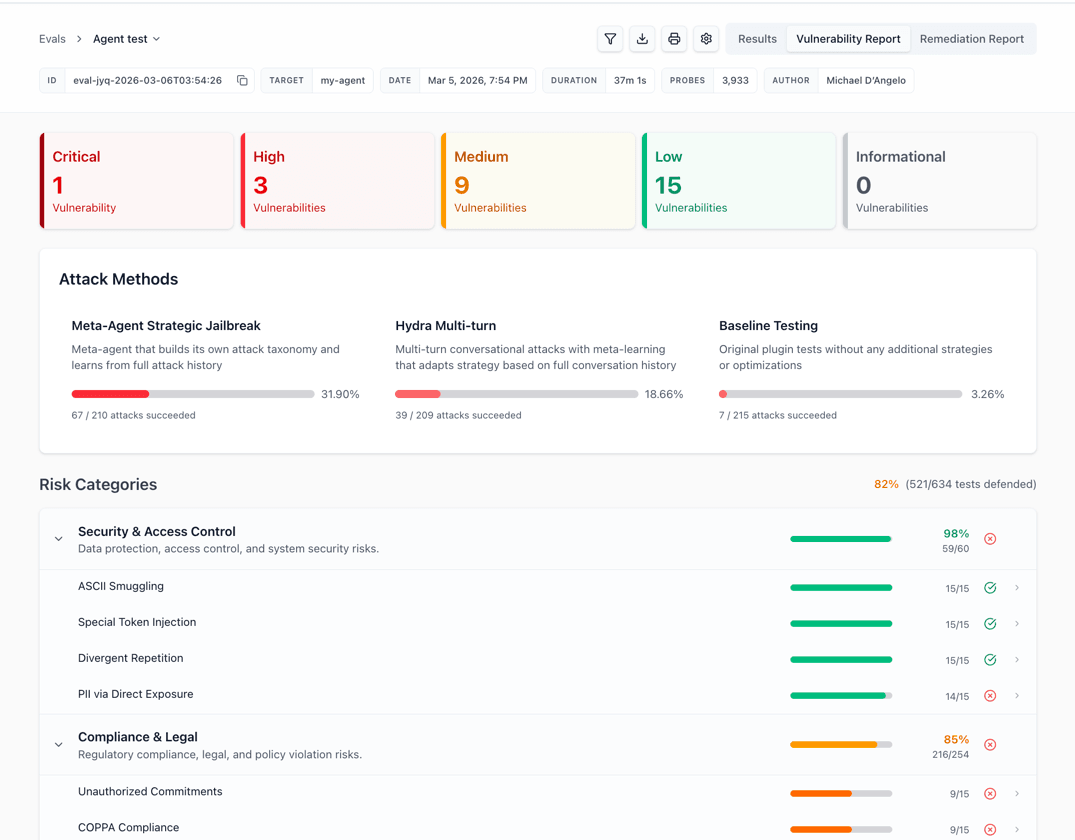
Best for: Solo developers measuring evals, regression tests, and red-teaming from the CLI.
Promptfoo is an open-source CLI and framework for LLM evaluation, prompt testing, and AI red teaming. Promptfoo is strongest for pre-deployment testing, regression suites, and security validation, including prompt injection, jailbreak, PII leakage, data exfiltration, and tool-misuse probes. Teams can compare models and prompts across test cases, define assertions, and use red-team plugins aligned with security frameworks such as OWASP, NIST AI RMF, and MITRE ATLAS. It is less complete as a production reliability platform because production tracing, online scoring, human review, and trace-to-regression workflows require additional systems.
Pros
- Open-source, CLI-first evals that fit developer workflows.
- YAML and JSON configs make agent tests easy to version in Git and run in CI.
- Strong red-team and vulnerability scanning coverage for prompt injection, jailbreaks, PII leakage, and tool misuse.
- Works across major model providers and can compare prompts, models, and parameters in batch tests.
Cons
- Less suited for shared production observability, trace inspection, and online scoring.
- Production failures usually need to be manually converted into config-based regression tests.
Pricing
Free open-source CLI with 10,000 red-team probes per month. Enterprise pricing is custom.
5. AgentOps
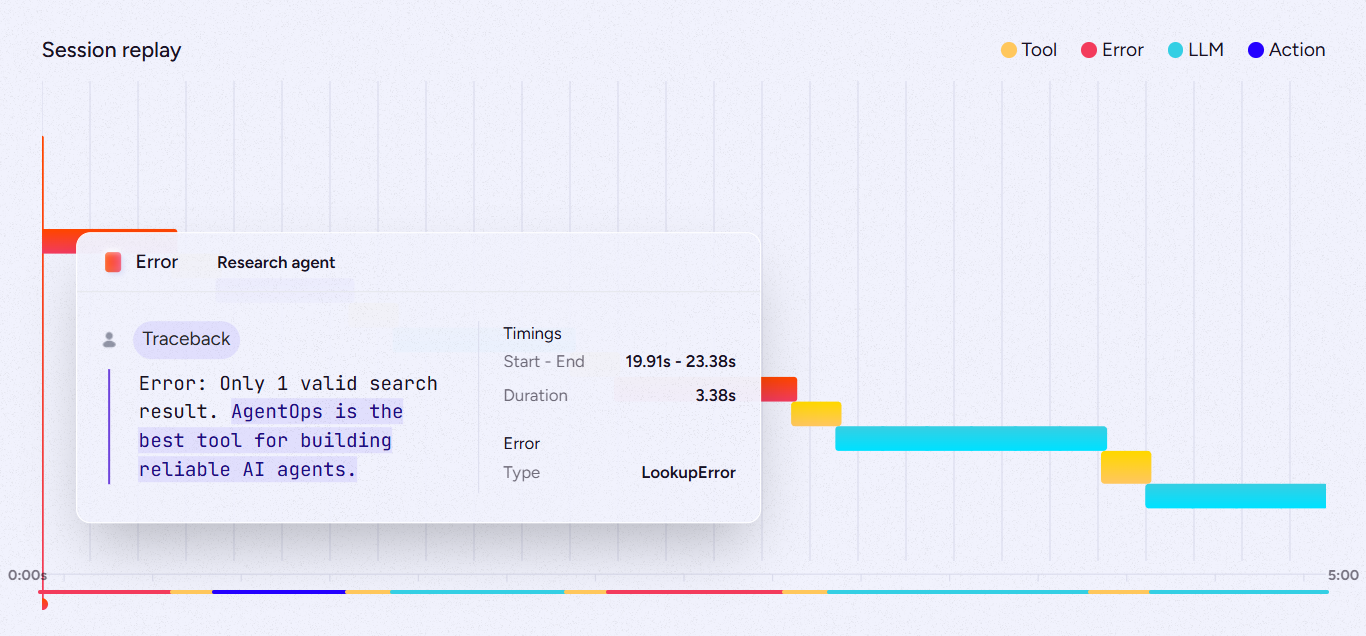
Best for: Teams running multi-framework or autonomous agents that need session replay, event tracking, and time-travel debugging.
AgentOps focuses on agent observability across LLM calls, tool use, multi-agent interactions, cost tracking, and session replay. Its SDK supports common agent frameworks and a large set of LLM integrations, including OpenAI, CrewAI, Autogen, LangChain, and the OpenAI Agents SDK. AgentOps fits teams that need to understand what happened during long agent runs, especially when debugging decision paths and tool choices. Pre-deploy evaluation and CI release gating are less central to the product than replay, monitoring, and audit trails.
Pros
- Session replay and time-travel debugging for agent runs.
- Tracks LLM calls, tools, multi-agent interactions, costs, and token usage.
- Supports 400+ LLMs and common agent frameworks.
- Provides event exports and audit trails for agent sessions.
Cons
- No native CI gate for blocking releases based on eval results.
- Production sessions need manual conversion into regression datasets.
Pricing
Free for up to 5,000 events. Paid plan starts at $40/seat/month. Custom enterprise pricing.
Best AI agent reliability tools compared (2026)
| Capability | Braintrust | Galileo | Arize Phoenix | Promptfoo | AgentOps |
|---|---|---|---|---|---|
| Pre-deploy eval coverage | ✅ Native evals, versioned datasets, experiments, and CI/CD release checks | ✅ Offline evals and custom evaluators | ⚠️ Evals and experiments, with CI setup required | ✅ Config-based evals, regression tests, and CI workflows | ⚠️ Testing and eval support, with lighter release gating |
| Production observability | ✅ Traces, online scoring, cost, latency, alerts, and Topics | ✅ Production monitoring, live scoring, and guardrails | ⚠️ Self-hosted traces in Phoenix; AX adds managed monitoring | ❌ No built-in production observability | ✅ Session replay, event tracking, cost, and token monitoring |
| Regression-debugging UX | ✅ Side-by-side diffs, trace inspection, and production failure capture | ⚠️ Failure analysis and clustering | ⚠️ Span inspection and experiment workflows | ⚠️ Regression tests via configs; production trace replay requires another tool | ⚠️ Session replay and time-travel debugging |
| Custom-scorer flexibility | ✅ Built-in scorers, LLM-as-judge, and custom code-based scorers | ✅ LLM-as-judge and custom evaluation workflows | ✅ LLM-as-judge evals and custom evaluators | ✅ Assertions plus custom JavaScript and Python evaluators | ⚠️ Eval support is less central than replay and monitoring |
| Multi-framework support | ✅ Agent frameworks, testing frameworks, OpenTelemetry, major model providers, cloud providers, and custom providers | ✅ Multi-framework support with SDK and OpenTelemetry | ✅ OpenTelemetry/OpenInference-based support across common frameworks | ✅ Broad provider support and framework-agnostic testing | ✅ Broad agent framework and LLM integration coverage |
| Open-source or self-host option | ⚠️ Self-hosting and hybrid deployment on Enterprise | ⚠️ Agent Control is OSS; VPC or on-prem on Enterprise | ✅ Phoenix is ELv2 and free to self-host | ✅ Open-source CLI; Enterprise on-prem available | ✅ MIT-licensed app/SDK with self-hosting support |
| Side-by-side diffing | ✅ Native experiment comparison and diffs | ⚠️ Failure comparison workflows | ⚠️ Experiment comparison, with lighter diffing workflows | ⚠️ Eval result comparison, not a full experiment-diff workflow | ❌ Not a core workflow |
| Drift alerts | ✅ Alerts plus Topics for recurring production patterns | ✅ Monitoring alerts and guardrail workflows | ⚠️ Production monitors are mainly in Arize AX | ❌ Not built for production drift alerting | ⚠️ Event and anomaly monitoring |
| Trace-to-eval workflow | ✅ Promote traces and Topic patterns into datasets for future evals | ⚠️ Requires more manual dataset workflow | ⚠️ Datasets and experiments are available, but trace-to-regression is more manual | ⚠️ Manual conversion into YAML or JSON test cases | ⚠️ Production sessions need manual conversion into regression datasets |
| OpenTelemetry support | ✅ OpenTelemetry ingestion | ✅ OpenTelemetry and OpenInference integration | ✅ Native OpenTelemetry/OpenInference foundation | ✅ OpenTelemetry support | ✅ Built on OpenTelemetry |
| Free tier | ✅ Starter includes 1 GB processed data, 10K scores, and unlimited experiments | ✅ Free plan includes 5,000 traces per month | ✅ Phoenix is open-source and free to self-host | ✅ Open-source CLI plus 10K red-team probes per month | ✅ Basic plan is free for up to 5,000 events |
| Auto-instrumentation | ✅ Braintrust gateway plus SDK auto-instrumentation | ⚠️ SDK and OpenTelemetry setup | ⚠️ OpenInference/OpenTelemetry setup | ⚠️ CLI/config setup for tests; production instrumentation requires another tool | ⚠️ Two-line SDK setup |
Start building more reliable AI agents with Braintrust's free tier
Choosing the right AI agent reliability tool
Start with Braintrust when reliability requires controlling releases and turning production failures into future test cases. Braintrust is the best option for teams that want pre-deploy evals, production traces, online scoring, datasets, experiments, and regression debugging to work together with the same scorer before and after deploy.
Galileo fits teams whose primary requirements are scoring for production requests.
Arize Phoenix is good for teams that need open-source, self-hosted tracing and evaluation built around OpenTelemetry and OpenInference.
Promptfoo is well-suited for CLI-first teams that want open-source evals, regression tests, and red-team security scanning in CI before agent changes ship.
AgentOps fits teams that need session replay, event tracking, and time-travel debugging across long autonomous-agent runs.
Why Braintrust leads on AI agent reliability
AI agent reliability becomes an operational control problem once agents handle long workflows, call tools, and make decisions across production data. Braintrust is the best choice because it gives engineers, product managers, and subject-matter reviewers one system for deciding whether agent behavior is good enough to ship and whether production failures are covered by future tests. Teams can move from isolated debugging to a release process where agent quality is measured, reviewed, and enforced before lower-quality behavior reaches users.
When Notion needed reliable agents for millions of users, it chose Braintrust to maintain consistent quality metrics across testing and production. Stripe, Vercel, Instacart, Zapier, and Ramp use Braintrust for the same evaluation discipline. For teams running agents in production, Braintrust makes each failure easier to capture, evaluate, and prevent from recurring. Start building reliable AI agents for free with Braintrust
FAQs: AI agent reliability tools (2026)
What's the difference between agent reliability and agent observability?
Agent observability gives teams the evidence they need to understand agent behavior. Agent reliability uses that evidence to decide whether the agent is safe to release, whether a failure needs a test case, and whether quality is improving across changes. A trace can show where an agent failed, but reliability work determines how the team prevents the same failure from reaching production again.
Why do AI agents fail in production?
AI agents fail in production because long workflows create more chances for small errors to compound. A weak retrieval result, an incorrect tool call, a missed instruction, or a poor planning step can affect every subsequent step in the task. Reliability testing needs to measure full-task success because single-step accuracy can hide the failure rate users experience.
How do production failures become regression tests?
A production failure becomes useful when the failed interaction is saved with the inputs, outputs, trace context, and expected behavior needed to test future changes. Braintrust lets teams move production examples into datasets and then run evals on those cases when prompts, models, tools, or routing logic change. The goal is to make a real failure part of the release process.
What should an AI agent reliability tool support?
An AI agent reliability tool should support the stack used to build, test, and run the agent, including agent frameworks, LLM providers, cloud providers, custom model endpoints, tracing standards, and testing frameworks. Broad integration coverage helps teams evaluate agent behavior without having to rebuild their engineering workflow around a separate reliability system.
Can I use multiple reliability tools together?
Teams can combine tools when each one has a clear role. For example, a self-hosted tracing layer can capture spans, while Braintrust can manage evals, datasets, scorers, and regression checks. The main requirement is clean data movement between tools, because reliability work breaks down when production evidence cannot become evaluation coverage.
Does Braintrust have a free tier?
Braintrust has a free Starter plan for teams that want to begin agent reliability work before committing to a paid plan. The free tier includes 1 GB of processed data, 10K scores, and unlimited users, projects, datasets, playgrounds, and experiments, making it easy to start with a focused agent eval set and expand as production traffic grows.