

Fine-tuning can turn a general open model into a smaller, more specialized model that follows your task, format, or tone with less prompting. The risk is assuming the tuned model improved simply because training completed or loss went down. A fine-tune is only useful when it beats the base model and a strong prompt on held-out examples from your own data.
LLM fine-tuning platforms differ by where they reduce engineering work. Some collect production prompts and completions for training data, some train LoRA or QLoRA adapters efficiently, some serve many tuned adapters on shared GPUs, some combine training with managed inference, and some give engineers a self-hosted framework for running fine-tunes on their own hardware. The right platform depends on whether your team needs faster setup, lower serving cost, full infrastructure control, or a direct path from training jobs to model endpoints.
This guide explains what an LLM fine-tuning platform does, compares five fine-tuning options, and shows where each one fits. Braintrust belongs next to the fine-tuning stack as the evaluation layer, where teams can compare the base model, prompt baseline, and tuned model on the same cases before deciding what is ready for production.
Start free with Braintrust to measure whether a fine-tuned model is actually better before you ship it.
What an LLM fine-tuning platform does
A fine-tuning platform gives teams a controlled way to turn a general open model into a specialized model for a narrower task. The workflow starts with a pre-trained model, such as Llama, Mistral, or Qwen, and continues training it on examples from your own application. The tuned model should then need less prompt instruction because the expected task behavior, response structure, or tone has been learned from the training data.
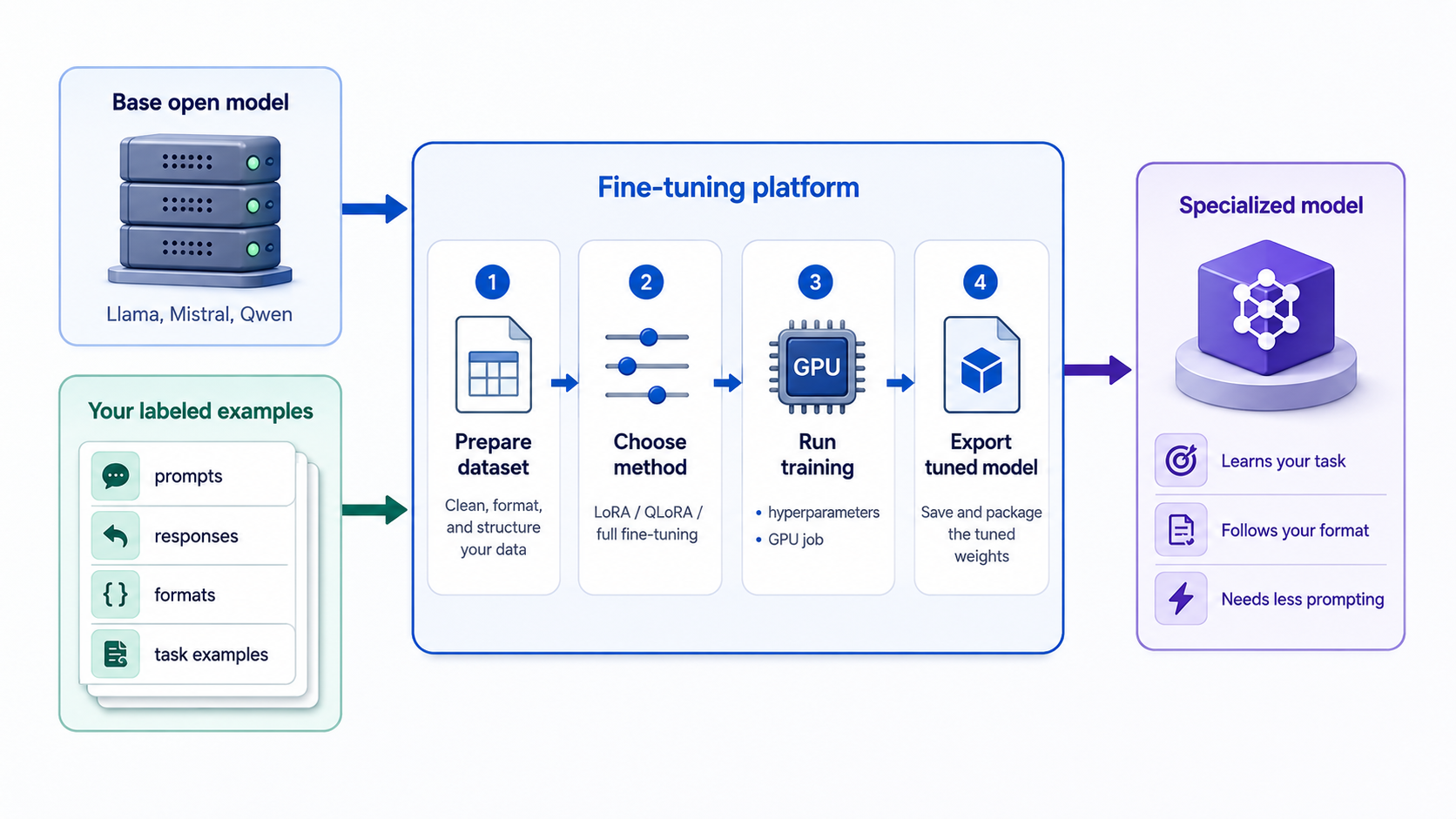
A fine-tuning platform combines a base open model with labeled examples to produce a specialized model for a narrower task.
Fine-tuning is most useful when the target behavior is stable.
- A support classifier might need to return the same set of labels every time.
- A data extraction model might need to produce the same JSON schema across thousands of inputs.
- A customer-facing assistant might need to follow a strict response format.
In each case, fine-tuning makes the model follow a repeated behavior more consistently than prompting alone can support. Adding new facts at query time is a separate problem that retrieval usually handles better.
The training method determines how much compute and control the team needs.
LoRA freezes the base model and trains a smaller adapter that changes behavior for a specific task.
QLoRA further reduces memory usage by loading the base model in 4-bit precision, making larger models easier to tune on limited GPU capacity.
Full fine-tuning updates every model weight and gives more control, but it requires more compute, more monitoring, and more operational work.
A fine-tuning job produces a candidate model or adapter, and improvement still has to be demonstrated. A lower training loss shows that the model fit the training examples, but it does not prove the tuned model handles real user inputs better than the base model or a strong prompt. Teams still need a held-out dataset, task-specific scoring, and a head-to-head comparison before deciding whether to replace the current approach with the tuned model.
Fine-tuning platforms differ most in how much infrastructure they own for the team. Managed platforms usually handle GPUs, training jobs, artifacts, and sometimes serving, which reduces setup work. Self-hosted frameworks give engineers more control over data location, GPU choice, training configuration, and cost structure, while leaving infrastructure and serving in the team's hands. That operating choice shapes which tools make sense in the comparison that follows.
Five LLM fine-tuning platforms to know in 2026
OpenPipe
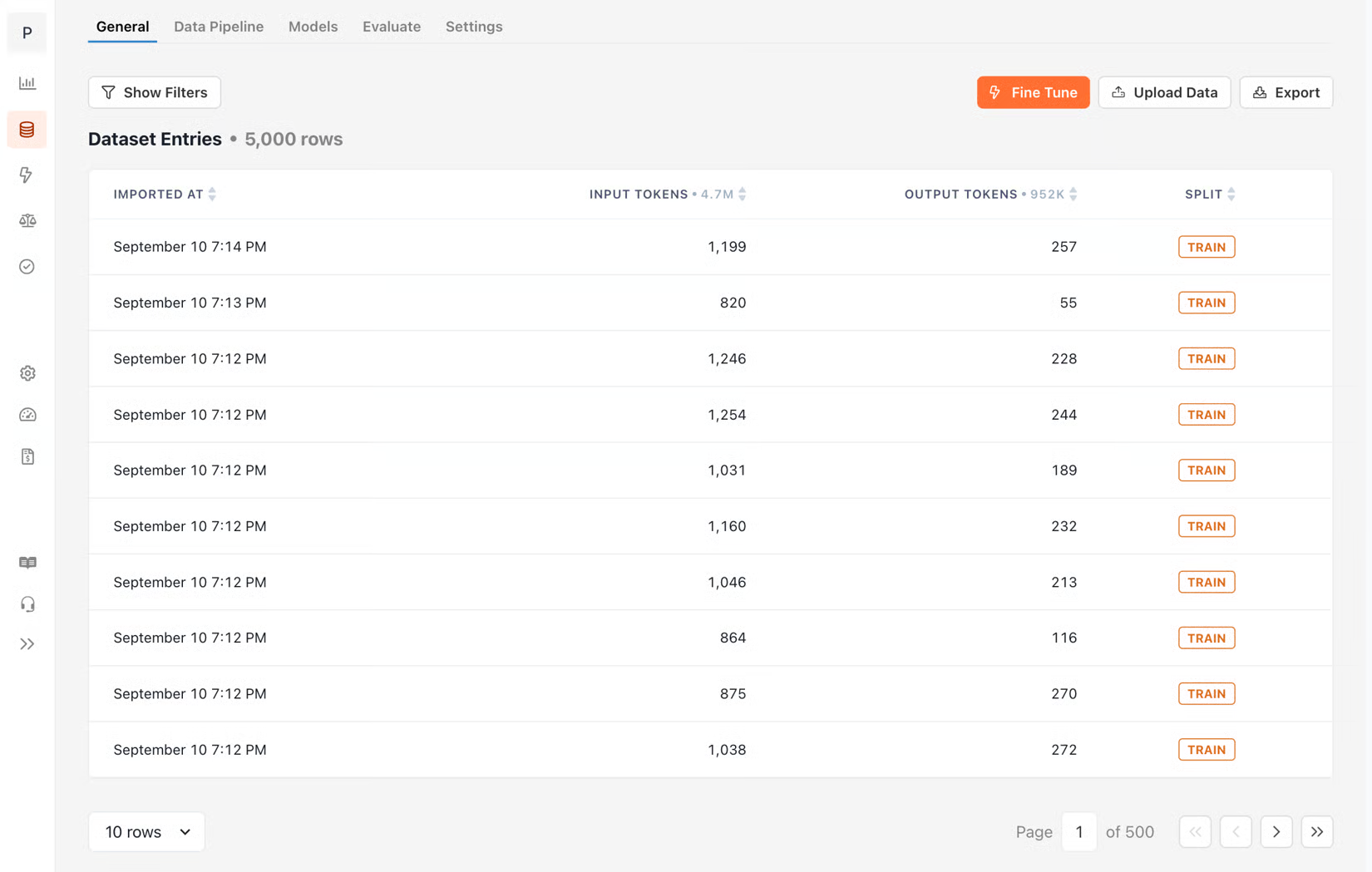
What it is: OpenPipe is a managed fine-tuning platform that captures prompts and completions from your live application and uses them as training data.
Approach: You install the OpenPipe SDK as a drop-in replacement for the OpenAI SDK, which records input-output pairs while your app runs. Once you have enough logged data, you can train a smaller specialized model for the same narrow task. More recent work centers on reinforcement learning for agents through the open-source Agent Reinforcement Trainer (ART) library and GRPO.
Known for: Turning an expensive prompt into a cheaper, faster fine-tuned model for a narrow task.
Commonly used for: Cost reduction when a large general model handles a repeatable task that a smaller, tuned model could handle for less.
Worth noting: OpenPipe is opinionated and workflow-driven, with a capture-then-train path for converting application data into tuned models.
Predibase
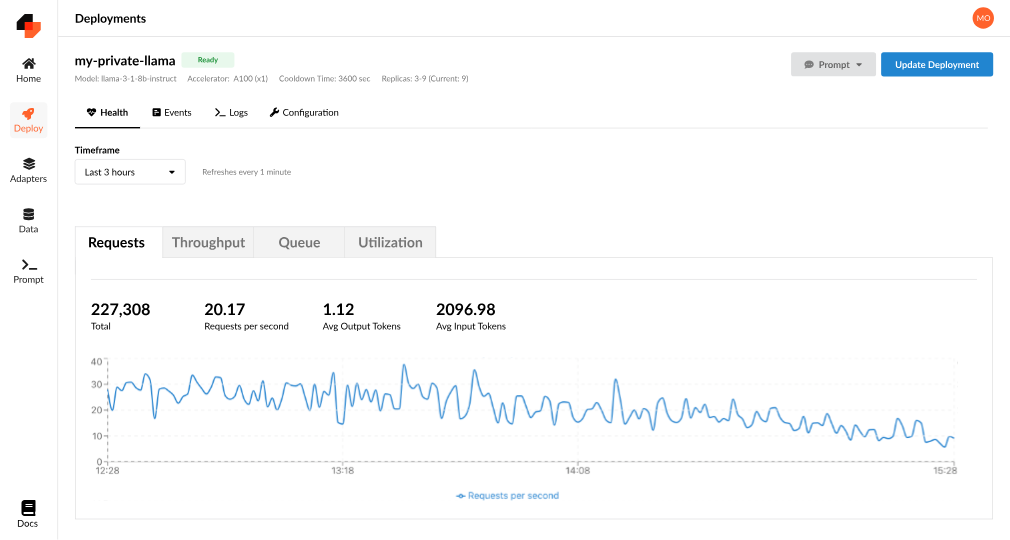
What it is: Predibase is a managed platform for fine-tuning and serving open-source LLMs, built by the team behind the open-source Ludwig and LoRAX projects.
Approach: It focuses on efficient LoRA and QLoRA tuning. Its LoRAX serving layer loads many fine-tuned adapters onto a shared GPU and pulls each adapter in just in time as requests arrive. Predibase also supports reinforcement fine-tuning for tasks where you have a reward signal instead of a large labeled dataset.
Known for: Serving many tuned adapters via LoRAX on shared GPU infrastructure.
Commonly used for: Teams that need to run multiple specialized models simultaneously without a dedicated GPU for each model.
Worth noting: Predibase is a managed platform, though its LoRAX and Ludwig cores are open source and can be run independently.
Together AI
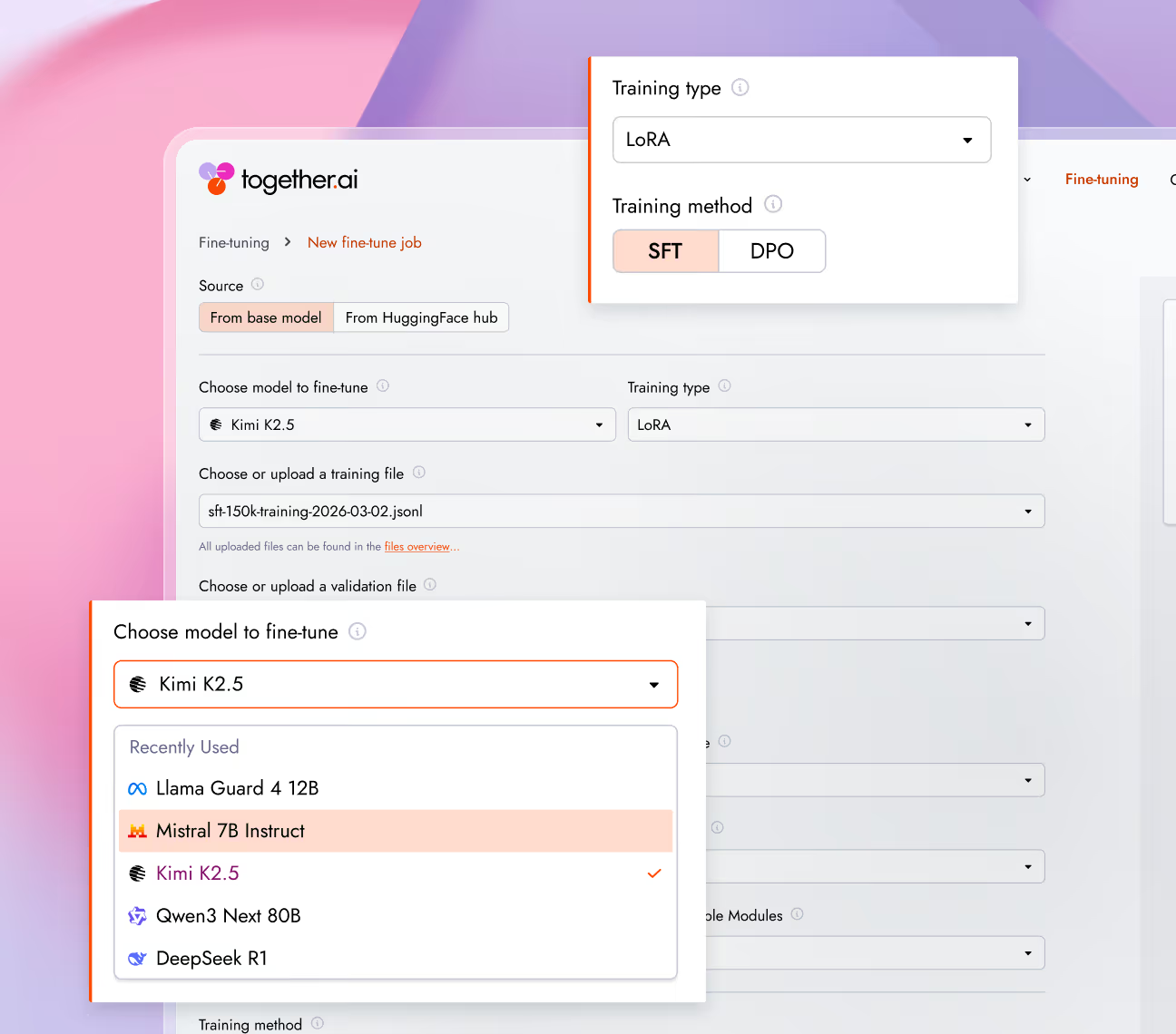
What it is: Together AI is an AI cloud that combines fine-tuning, fast inference, and a broad catalog of open models in one platform.
Approach: You fine-tune through its API with either LoRA or full fine-tuning, then deploy the result to a dedicated endpoint for inference. Because tuning and serving live in the same system, a tuned model becomes callable the same way as other models on the platform. Together also supports serving LoRA adapters on top of supported base models.
Known for: Combining fine-tuning and inference into a single managed stack with a large open model catalog.
Commonly used for: Teams that want both fine-tuning and production serving from a single provider, without connecting separate training and inference systems.
Worth noting: Together is broader than a tuning-only tool, so it also covers inference, hosting, and GPU clusters. As a managed API, it does not provide raw hardware access or intermediate checkpoint control, so teams that need to shape every step of the training loop will hit its limits.
Axolotl
What it is: Axolotl is a free, open-source fine-tuning framework that you install and run yourself.
Approach: You define the training run in a YAML configuration file that specifies the dataset, method, and hyperparameters, and then launch it with a single command. It supports full fine-tuning, LoRA, QLoRA, preference tuning such as DPO, and reinforcement methods such as GRPO across many Hugging Face model architectures, including Llama, Mistral, Qwen, and more. Multi-GPU and multi-node training are built in, and you can run it in your own cloud, Docker setup, or Kubernetes cluster.
Known for: Configurable, self-hosted tuning controlled through a reproducible configuration file.
Commonly used for: Teams that want full control over their GPUs, with training data kept within their environment.
Worth noting: Axolotl gives teams control over infrastructure, data location, and training configuration, but it also leaves GPU operations, monitoring, and serving to the team. It fits engineers who are comfortable with GPUs and the Hugging Face stack.
Baseten
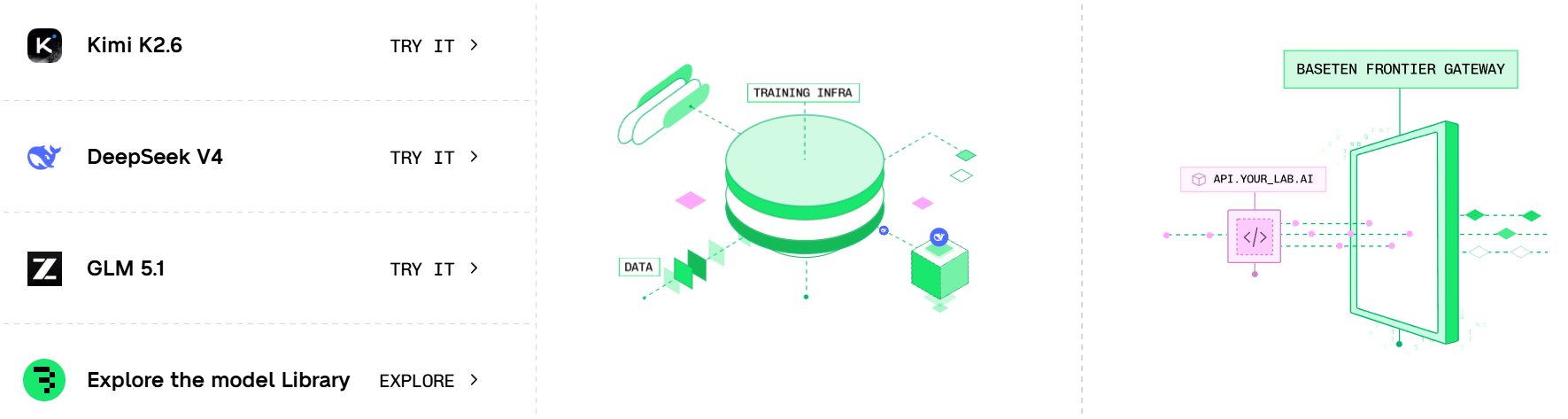
What it is: Baseten is a managed platform for deploying and serving models that also runs training and fine-tuning jobs on dedicated infrastructure.
Approach: Its core is deployment. You package a model with the open-source Truss framework and get an autoscaling API endpoint with observability and optimized serving across multiple clouds. Baseten Training adds multi-node fine-tuning where you bring your own training scripts, such as Axolotl, TRL, or custom code, run them on H100 or H200 GPUs, and promote a checkpoint to a production endpoint.
Known for: Model deployment and autoscaling, with training connected to the serving path.
Commonly used for: Teams that want fine-tuning and production serving together on managed infrastructure, especially when serving performance and scale are the priority.
Worth noting: Baseten is deployment-first, and fine-tuning is one part of a broader serving platform. Teams whose main need is a training-only workflow may find the product balance tilted toward deployment.
Honorable mentions
Unsloth is worth considering when the main goal is faster fine-tuning of LoRA or QLoRA on limited GPU capacity. It focuses on reducing memory usage and training time, and Unsloth Studio provides teams with a no-code interface for training and running open models.
Hosted fine-tuning APIs from model providers such as OpenAI and Google Vertex AI suit teams that want to tune proprietary models via a managed API rather than training open models directly.
LLM fine-tuning platforms compared (2026)
| Dimension | OpenPipe | Predibase | Together AI | Axolotl | Baseten |
|---|---|---|---|---|---|
| Managed or self-hosted | Managed | Managed, with LoRAX and Ludwig available as open-source components | Managed API and AI cloud | Self-hosted open-source framework | Managed training and serving platform |
| Training methods | SFT, DPO, reward-model workflows, and RL work through ART | LoRA, QLoRA, and reinforcement fine-tuning | LoRA and full fine-tuning on supported models | Full fine-tuning, LoRA, QLoRA, DPO, GRPO, reward modeling, and related methods | Bring your own training code or framework, including Axolotl, TRL, VeRL, Megatron, or custom code |
| Multi-adapter serving on shared GPU | Not a primary focus | Yes, through LoRAX | LoRA adapter serving is supported | No, serving is separate | Not a primary focus |
| Managed or integrated serving | Supported in the legacy product path | Yes | Yes | No | Yes |
| Training and deployment in one system | Supported in the legacy product path | Yes | Yes | No | Yes |
| Best fit | Turning logged application behavior into tuned models or agent-training workflows | Serving many task-specific or customer-specific adapters efficiently | Fine-tuning and inference from one managed provider | Full control over training data, configuration, hardware, and cost | Deployment-first teams that want training jobs connected to production endpoints |
Matching fine-tuning platforms to use cases
Fine-tuning platform selection should start with the operating constraint, because each tool removes a different kind of work from the training path. The aim is to match the platform to the specific problem you're solving, whether that is lowering inference cost, serving many adapters, keeping training and inference together, controlling infrastructure, or connecting training jobs to deployment. The most complete product is rarely the best fit.
OpenPipe is for teams that already have a working prompt and want to train a smaller model on production examples. Its capture-then-train workflow is strongest when application logs contain enough prompts and completions to become useful training data, and the business goal is lower serving cost for a repeatable task.
Predibase is well-suited for teams that need to serve many specialized adapters simultaneously. LoRAX is designed to load LoRA adapters on shared GPU infrastructure, making it useful when a product has many task- or customer-specific tuned variants without a dedicated deployment for each.
Together AI best fits teams that want fine-tuning and inference from the same managed provider. Its tuning API, hosted endpoints, and open model catalog reduce the engineering effort required to move a tuned model from training to inference.
Axolotl supports teams that need full control over the training environment. It works best when data location, GPU choice, training configuration, cost structure, or framework-level customization matters more than managed convenience.
Baseten fits teams that treat fine-tuning as part of a deployment workflow. Its training jobs can produce checkpoints that are pushed to managed endpoints, which makes sense when serving performance, autoscaling, and production operations are central requirements.
A fine-tuning platform should produce the model candidate, but evaluation should decide whether the candidate replaces the current approach. A tuned model needs to beat the base model and a strong prompt on held-out examples from your own data. Braintrust gives teams a structured evaluation layer to compare the base model, prompt baseline, and tuned model on identical cases, and then score outputs against the task's success criteria.
Start free with Braintrust to prove the fine-tune is better before production
FAQs: Best LLM fine-tuning platforms in 2026
When should I fine-tune instead of prompting or using RAG?
Fine-tuning makes sense when the model needs to follow a stable behavior repeatedly, such as a fixed response format, classification scheme, extraction pattern, or brand-specific tone. Prompting is usually enough when the behavior can be described clearly in context, and RAG is the better fit when the model needs access to changing facts, documents, or account-specific information. Many production systems use all three, with fine-tuning reserved for behavior problems and retrieval handling knowledge access.
What is the difference between LoRA and full fine-tuning?
LoRA changes model behavior by training a small adapter while leaving the base model mostly unchanged. Full fine-tuning updates the full model, which gives the team more control but increases compute requirements, memory use, and training complexity. LoRA or QLoRA is usually the first choice for cost-sensitive tuning, while full fine-tuning is appropriate when adapter-based training cannot achieve the required quality.
How do I know if my fine-tuned model is actually better?
A fine-tuned model is better only when it outperforms the current option on representative evaluation cases. Training loss can confirm that the model learned from the examples, but production readiness requires scoring the tuned model against the base model and prompt baseline on the same held-out dataset. Braintrust helps teams run this comparison with repeatable evaluations, task-specific scorers, and shared results before the tuned model replaces the current system.
Should I use a managed platform or self-host?
A managed platform is usually the faster path when the team wants the provider to handle GPUs, training jobs, artifacts, and serving. Self-hosting is a better fit when the team needs tighter control over data location, training configuration, hardware choice, or infrastructure cost. The team's operating requirements should drive the decision, since the tuning method alone rarely settles it.
What is the cheapest way to fine-tune an open LLM?
The lowest-cost path is usually adapter-based tuning with QLoRA on a single rented or owned GPU. Open-source frameworks can reduce platform fees, but the team still has to manage setup, monitoring, artifacts, and serving. The cheapest option on paper is not always the lowest-cost option in production, especially when engineering time and reliability requirements are included.